Skip to content
About J.R. Hernandez

Psychotherapist, Specialized in Burnout and Mood Disorders

I am J.R. Hernandez, a psychotherapist specializing in burnout and mood disorders, and the founder of Baseline Psychotherapy, an online private practice serving professionals, expats, and high performers worldwide, in both English and Spanish. I founded the practice in New York in 2019, and today it is based in Singapore. Since then, I have worked with clients from more than 21 countries.

My approach is both process-based and evidence-based. I begin every case with a structured clinical assessment, design each intervention around the specific mechanisms maintaining the problem, and track progress through clear, observable outcomes. Seven credentials support that method, ranging from Medical Neuroscience at Duke University School of Medicine to an Anxiety and Mood Disorders Specialization with the American Psychological Association.
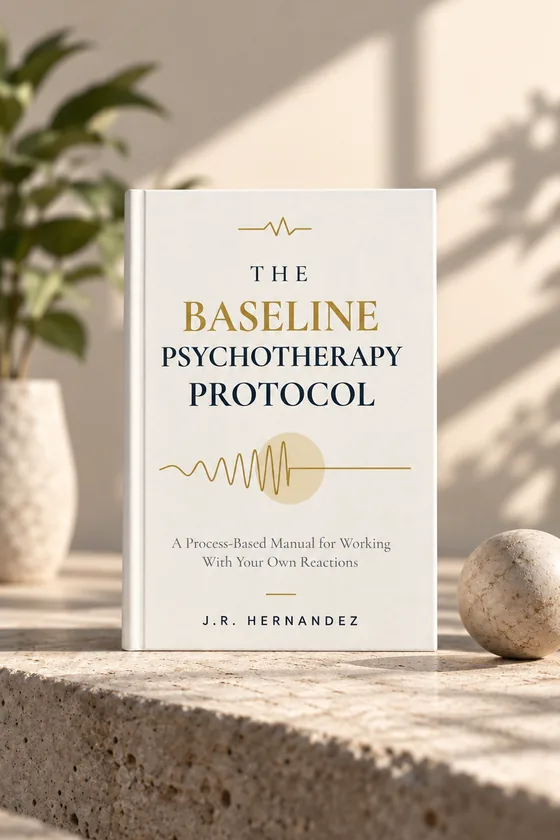

Founded in New YorkServing Clients WorldwideEnglish & Spanish

Clinical Approach

What Is Process-Based Therapy?

Process-based therapy (PBT) is a clinical framework that targets the specific mechanisms maintaining a person's difficulty (the cognitive, emotional, physiological, and behavioral processes at work) rather than applying a standardized protocol to a diagnostic label. The framework was formalized by Steven C. Hayes and Stefan G. Hofmann in 2018, and expanded in their 2019 research agenda in Clinical Psychological Science, as an evolution beyond one-size-fits-all, protocol-for-diagnosis treatment.

Baseline Psychotherapy has worked process-based since opening in 2019, within the first wave of clinical adoption of the framework, and has kept refining that practice since. In practice, the assessment maps what is maintaining the difficulty before any treatment is chosen, and the choice among evidence-based approaches, integrated under one framework (CBT, ACT, somatic and mindfulness-based methods), follows from that map, not from a fixed menu. Two clients with the same diagnosis can require different treatments; the framework exists precisely to handle that variability.

Sessions follow a defined structure: review of progress, a focused clinical target for the current session, practical tools or interventions applied in real time, and a clear direction for what to work on between sessions. Progress is tracked in observable terms every session. If something is not working, we adjust. This is not open-ended exploration. It is structured, measurable clinical work with a defined trajectory.

Education & Clinical Training

What Is J.R. Hernandez Trained In?

J.R. Hernandez holds seven credentials, listed here as issued: professional psychotherapy training, medical neuroscience, clinical specializations, and two postgraduate degrees, all in service of one thing: practicing process-based therapy with precision.

Professional Diploma in Psychotherapy (PDP)

The School of Positive Psychology of Singapore

The clinical backbone of every case. Structured assessment, outcome-tracked intervention, and the therapeutic relationship as a clinical tool. This training prioritizes structure over intuition: identifying what is maintaining the problem, determining which specific skills will shift it, and tracking whether the intervention is landing.

Medical Neuroscience

Duke University School of Medicine

A medical-level neuroscience foundation that bridges mind and body in clinical work. This training covers how the central nervous system organizes attention, arousal, emotion, and recovery. It is the basis for understanding why burnout is neurophysiological, why anxiety activates the body before it reaches conscious thought, and why sleep disruption, cognitive fatigue, and emotional reactivity connect at the level of neural circuitry.

Anxiety and Mood Disorders Specialization

American Psychological Association (APA)

Diagnostic precision for differentiating burnout from depression, primary anxiety from stress-driven activation, and mood instability from emotional dysregulation. In practice, this matters most at the assessment stage: ensuring the intervention targets what is actually driving the problem, not just the most visible symptom.

Integrative Medicine Specialization

University of Minnesota

The clinical framework for incorporating evidence-supported complementary approaches alongside standard psychotherapy. Guided imagery and mindfulness, covered in depth in this program, are among the most evidence-supported methods for downregulating the nervous system in burnout and chronic stress.

Telehealth Specialization

Duke University

Clinical competence in remote assessment, structured video-based interaction, and the ability to conduct evaluations that typically depend on physical presence. This specialization covers proper session preparation, patient-centered communication, and the neurological screening skills needed to identify cognitive and physiological presentations through a screen.

Master in Emotional Intelligence and Personal Development

Instituto de Estudios Psicológicos de España

A postgraduate degree in the science of emotions: how they are generated, how they dysregulate, and how they can be worked with systematically in therapy. This credential forms the foundation for emotion-focused intervention across burnout, anxiety, and depression. It supports the ability to trace emotional patterns to their neurophysiological source and intervene at the correct level.

Master of Arts in International Psychology

The Chicago School of Professional Psychology

Cross-cultural clinical expertise. Understanding how culture, migration, and identity intersect with psychological functioning. This training directly informs the work with expats, international professionals, and individuals navigating life across borders, languages, and cultural frameworks.

Why This Practice Exists

Built by an Expat,
for Expats and Global Professionals

Before I was a therapist to expats, I was one. Six countries across three continents: Venezuela, Chile, France, the United States, Singapore, Russia. Every relocation carried the same hidden pattern: rebuilding identity inside unfamiliar systems, often in a new language, performing competence while quietly exhausted, and grieving a life no one mourns with you, because leaving was your choice.

This is not a marketing angle. It is clinical relevance. When a client describes the disorientation of arriving in a new country, the identity confusion of living outside every previous context, or the strain relocation places on a relationship, I am not interpreting from theory. I am recognizing a pattern I have navigated personally and treated clinically in hundreds of sessions.

That pattern became this practice. Baseline Psychotherapy was born in New York in 2019 and has operated across time zones ever since, built for people whose exhaustion outlasts every vacation, whose anxiety has turned structural, and whose lives do not fit neatly into one country, one language, or one cultural framework.

Books & Research

What Has J.R. Hernandez Published?

J.R. Hernandez has published two books on emotional intelligence: a practical guide for adults and an illustrated book for children.

Emotional Intelligence and Behavioral Therapies by J.R. Hernandez

Emotional Intelligence & Behavioral Therapies

A 10-step guide integrating emotional intelligence into CBT for adults managing stress, anxiety, and depression.

Learn more →
Toto's Journey Through Emotions by J.R. Hernandez

Toto's Journey Through Emotions

A picture book for young children about naming and understanding emotions. For parents and educators.

Learn more →

Get Started

Start Your Process

If you have been running on fumes and know something has to change, the next step is a conversation, not a commitment. Reach out on WhatsApp to book your free 15-minute consultation. No referral, no waitlist, no intake form. You will hear back directly from J.R. Hernandez.

Free 15-minute consultationOnline via Google MeetEnglish & Spanish